
Statistical Analysis of American Focaccia Recipes (Hollywood Focaccia, Part 2)
For this analysis, I used R software (The R Project for Statistical Computing). For the figures, I mainly used the packages Tidyverse and Tidyplots.
My previous analysis of focaccia recipes began after watching an Instagram post where a famous Hollywood actress was making focaccia. Some viewers commented with doubts about the large amount of oil she used. In the meantime, Jennifer Garner shared the name of the recipe’s original author – it is included among those analyzed below.
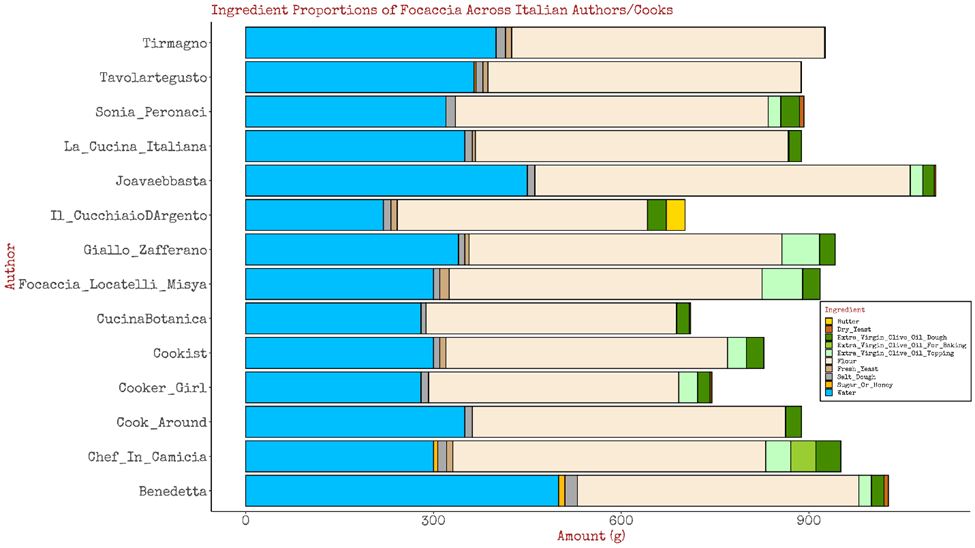
When examining the recipes from Italian authors for making focaccia, I found many similarities among them. For instance, the amount of oil used in the dough was generally in line with the quantities recommended by experts. The ingredients, and their amounts, were also quite similar, and almost all the authors suggested recipes using 500 grams of flour (to make about 900/950 grams of focaccia). Through statistical calculations, I identified the most balanced recipe, the “focaccia infallibile” (the “fail-proof focaccia”).
In American focaccia recipes, there is greater variation, but one commonality is that all authors use oil, which I have represented using the color green.

Differences and Missing Details in some Recipes
Compared to Italian recipes, some American ones also specify the amount of oil to be poured into the bowl used for proofing the dough. As a result, I added this variable to the American dataset as well.
In some cases, it was not clearly stated how much oil was used for the bowl or as a topping, but only the total amount was provided. In these instances, I counted the tablespoons if specified; otherwise, I left the cell blank.
Unlike Italian recipes, American ones do not use fresh yeast, only dry yeast.
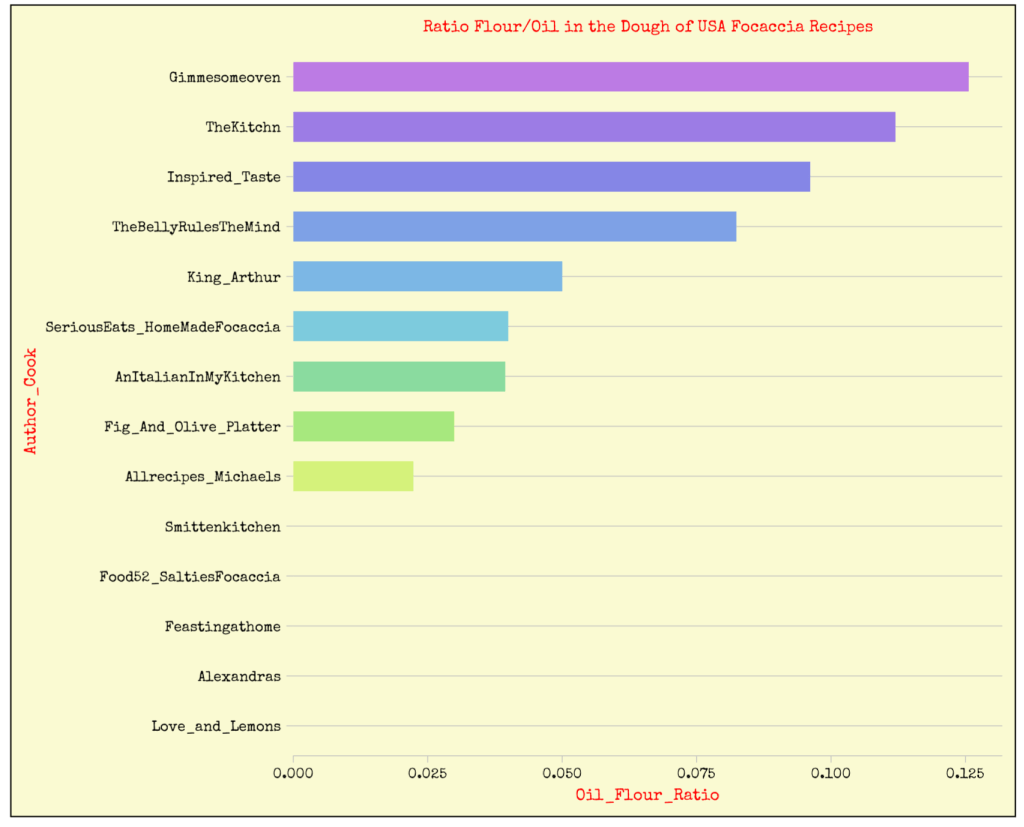
The purpose of this analysis was to investigate how much oil was added to the dough in the recipes proposed by various authors or well-known food bloggers. Since the amount of flour varies significantly between authors, I calculated the ratio of extra virgin olive oil to flour.
As shown below, many American authors do not use oil in the dough at all, while some use amounts within the range recommended by experts (between 3% and 4.5%, cit. H. McGee). Examples include All Recipes – Michaels, Fig and Olive Platter, An Italian in My Kitchen, and Serious Eats. Meanwhile, others use significantly higher amounts.
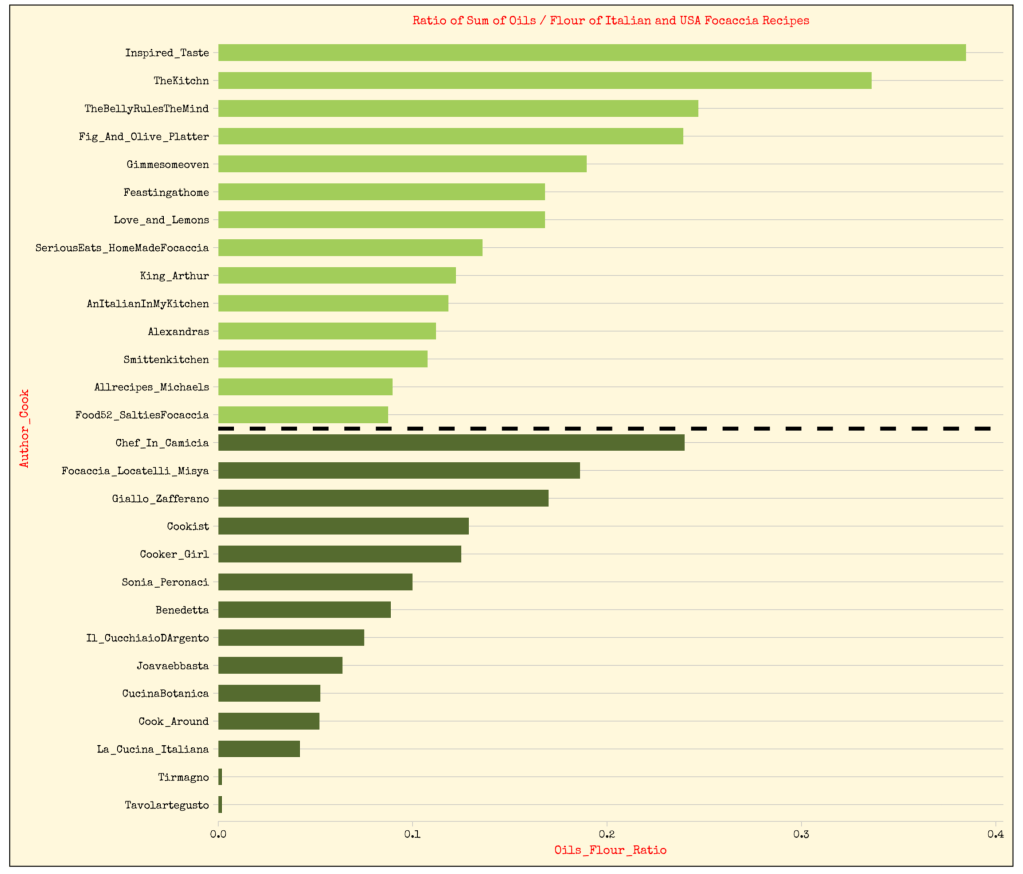
Some Italian authors also did not use oil in the dough, but it appears that more American authors omit it. Below are the proportions of extra virgin olive oil to flour across different Italian and American authors.
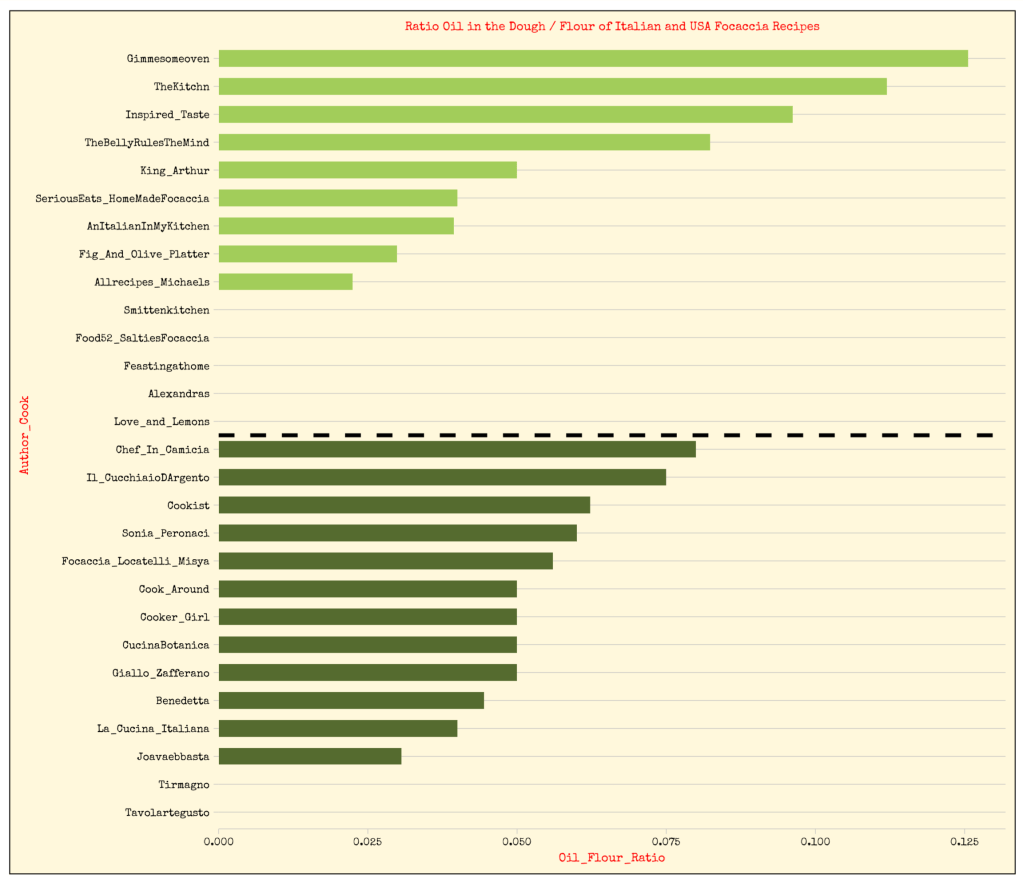
If we compare this with Figure 1, we see that all American recipes include oil, just not necessary in the dough.
So, where is the oil specified in these American recipes used?
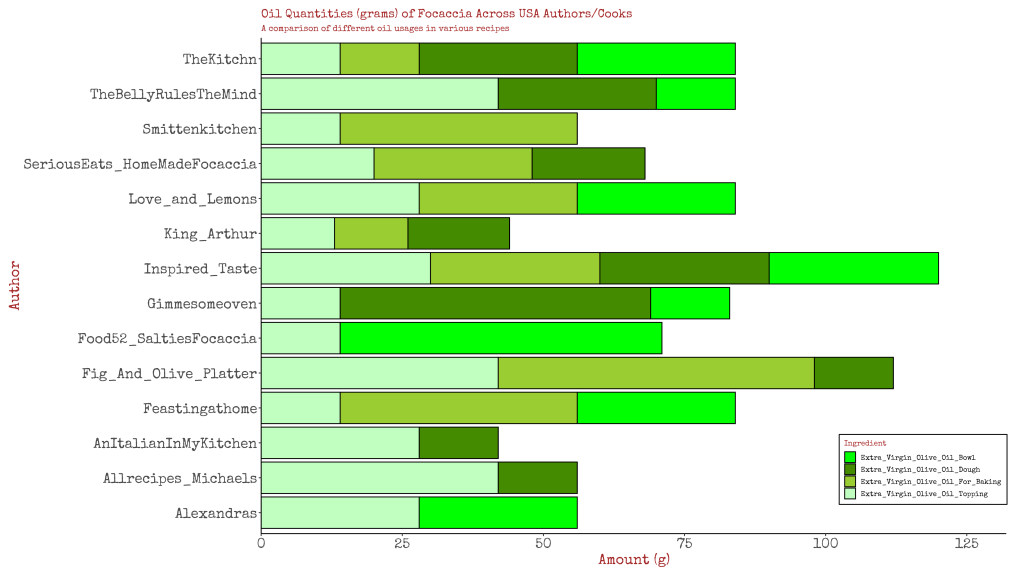
Some recipes do not specifically state how much oil is added to the pan for baking the focaccia, so I was unable to record this information. However, we can see that large amounts of oil are poured into the bowl beneath the dough before proofing. Some authors also use a substantial amount in the pan and on top of the dough (in addition to incorporating it into the dough itself).
The recipe used by Garner is from @alexandracooks and is not among those with the highest oil content. This suggests that the actress may have used custom measurements, as the ingredient list does not specify the oil amount, but it is added during preparation: Alexandra Cooks – Overnight Refrigerator Focaccia.
Below is the same chart showing the total oil used in Italian recipes. It appears that Italian authors fall into three groups: those who use a lot of oil, those who use a moderate amount, and those who do not use any at all. With a few exceptions, the Italian focaccia recipes generally call for less oil.
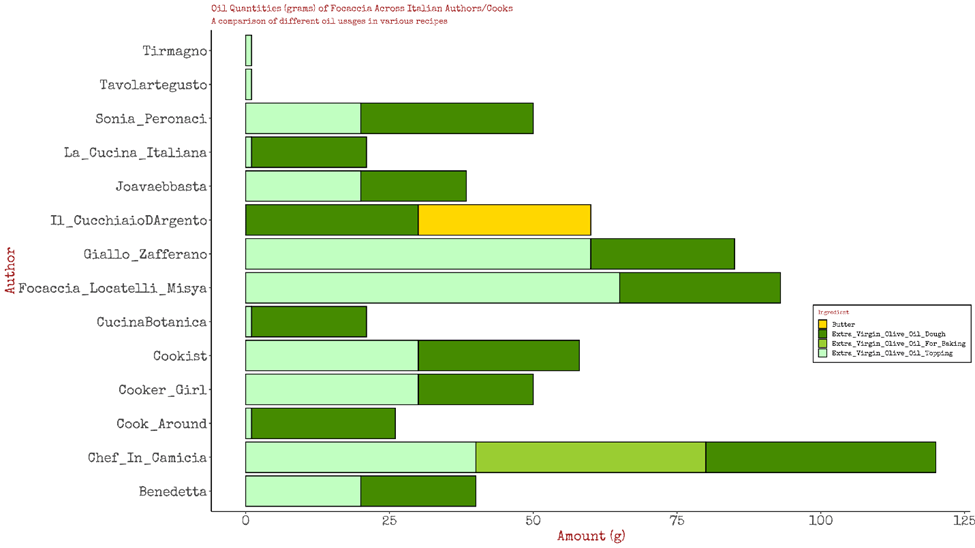
The total amount of oil is higher in American recipes, but much of it is not used in the dough
If we sum up all the oil used in each recipe, calculate the ratio of oil to flour, and compare Italian recipes with those from overseas, we see a clear difference. The amounts used in the light green bars (USA) are generally higher than those in the dark green bars (Italy).
Now that we’ve compared the recipes overall, let’s take a closer look at the details to get an idea of the most common oil quantities used in the U.S.—in the dough, in the bowl, for cooking, and as a topping.
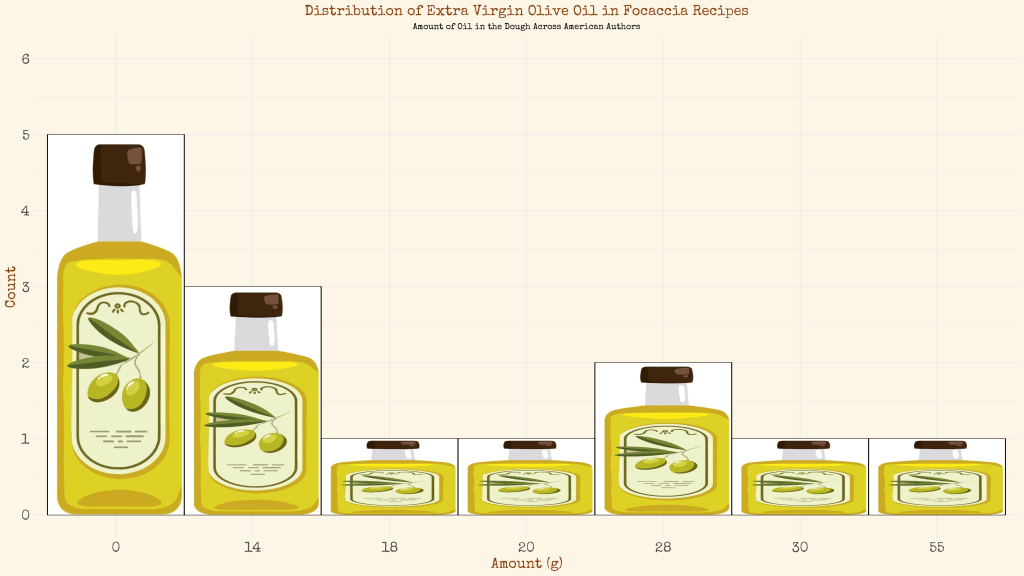
Histogram of oil used in the dough
Five authors do not use oil in the dough, three use 14 grams, two use 28 grams, one uses 18 grams, one 20 grams, one 30 grams, and one 55 grams.
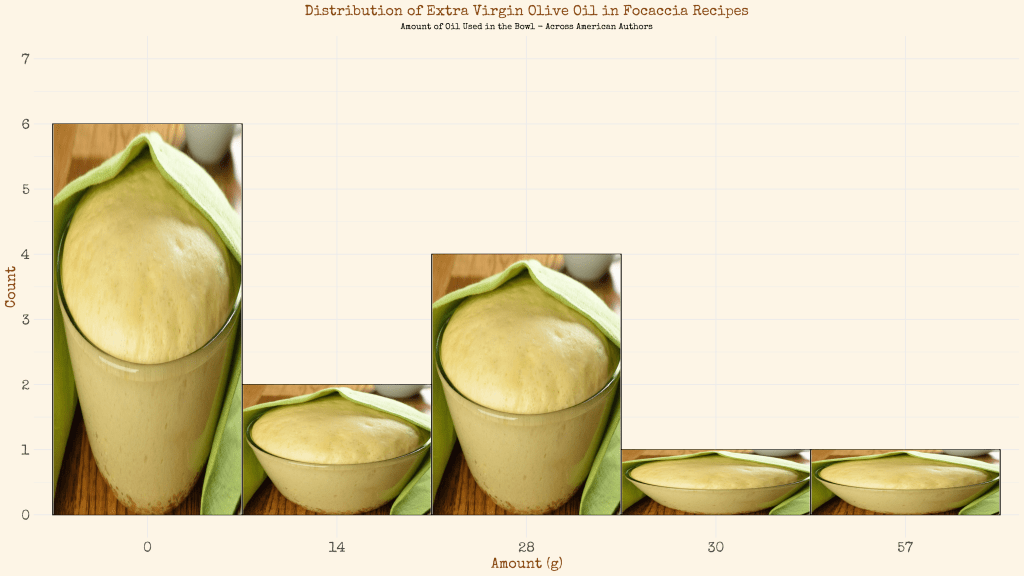
Histogram of oil poured into the bowl
Six authors do not specify or mention how much oil to use in the bowl used for the fermentation. This information could be simply omitted, or they do not use it at all, or the authors assume that readers know how much to use. Two recipes use 14 grams of oil, four recipes use 28 grams, one uses 30 grams, and one uses 57 grams. Considering that 28 grams of oil is roughly two tablespoons, we can see that some cooks are quite generous with the oil, even if the dough can absorb a limited amount of it, and much of the oil is likely discarded.
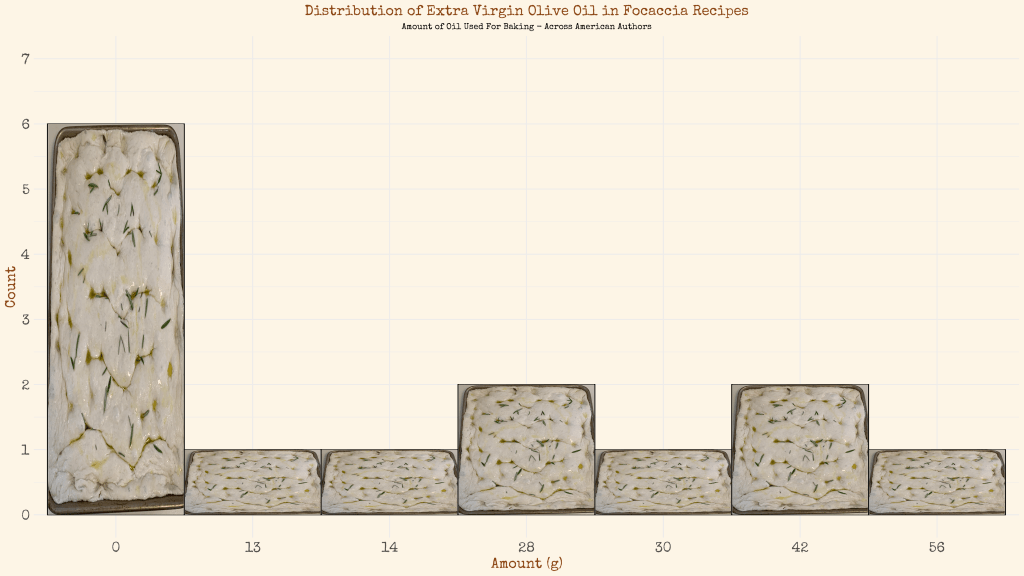
Histogram of oil used for baking
Also, regarding the oil used for baking the focaccia, six authors have omitted the quantity. Perhaps, once again, the authors assume that readers will know how much to use, but it is still important to mention that the baking tray needs to be greased before placing the focaccia, especially if the dough has a high hydration level. I use parchment paper lightly greased and recommend doing so. Note that while two recipes recommend small amounts of oil for baking (13 and 14 grams), others use 28 grams, one uses 30, two use 42, and one uses 56 grams.
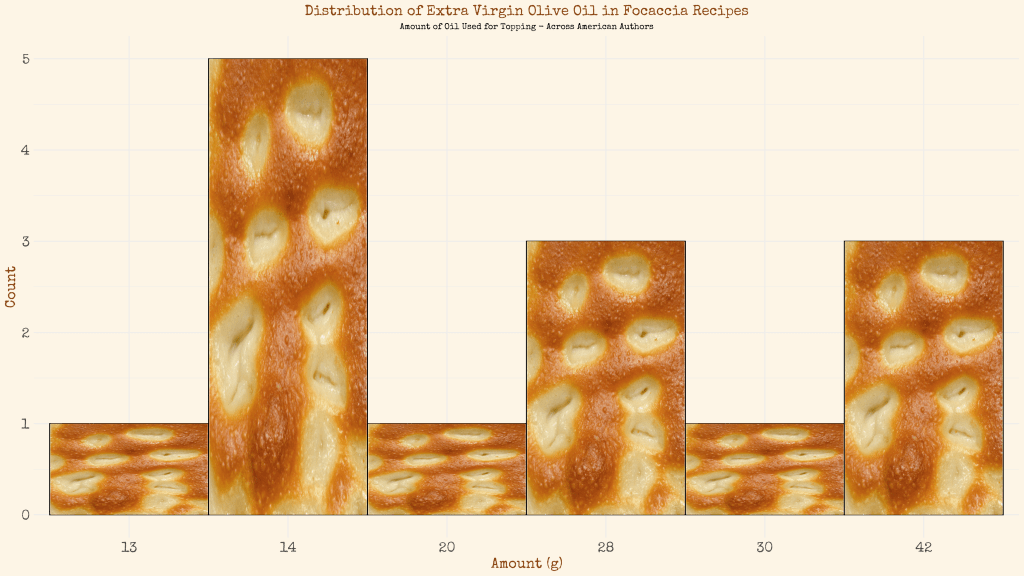
Histogram of oil used for the topping
For the topping, one author uses 13 grams, five authors use 14 grams (one tablespoon), one author uses 20 grams, three use 28 grams, one uses 30 grams, and three use 42 grams.
The oil used for the topping provides the golden and crispy crust that makes the focaccia so delicious. For the topping, most Italian authors use a mix of oil and water they call “emulsione”. One tablespoon of extra virgin olive oil mixed with one tablespoon of water is what I recommend for a golden not too dark crust. As an alternative, if you are really into oil and you cannot help yourself, you can use 1 and a half tablespoons of oil.
The Best American Focaccia
Unfortunately, some recipes lack details or are unbalanced. By calculating the Euclidean distance from the average of each recipe, the recipe that is most “central” is from Serious Eats. The recipe is available here: https://www.seriouseats.com/easy-no-knead-focaccia
Regarding the ratio of water to flour, Serious Eats ranks in the middle of the graph, with a high-hydration focaccia using 400 grams of water for 500 grams of flour, resulting in a liquid ratio of about 80%. In the previous analyses conducted, this recipe, which seems to be the best, ranked roughly in the middle both for oil in the dough and when considering the total amount of oil.
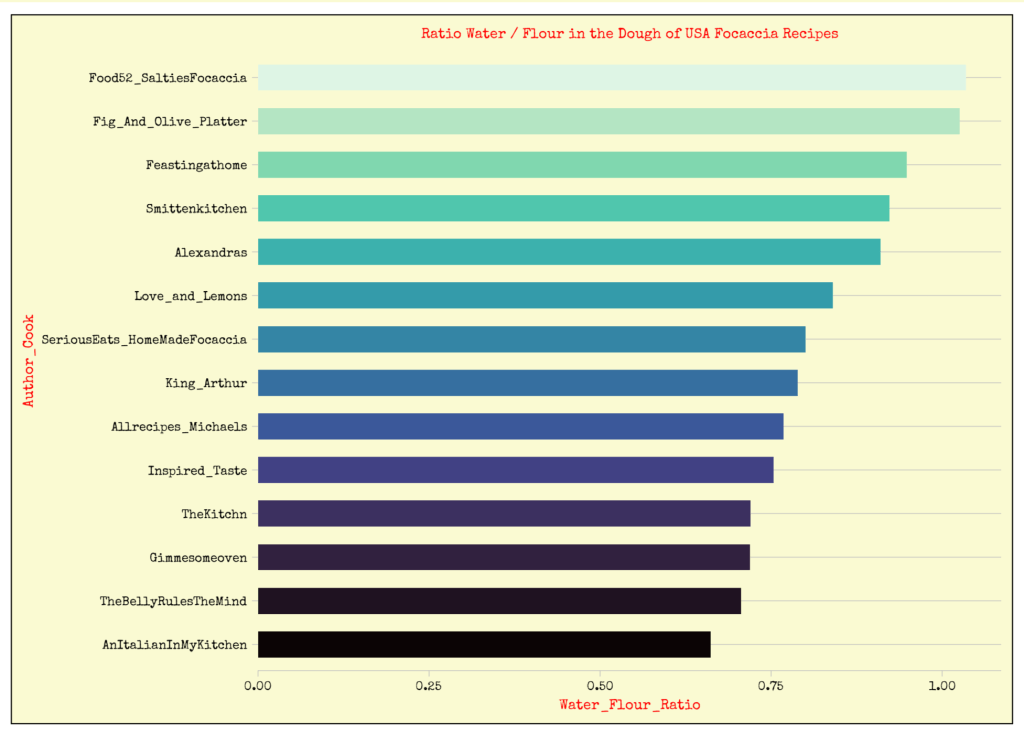
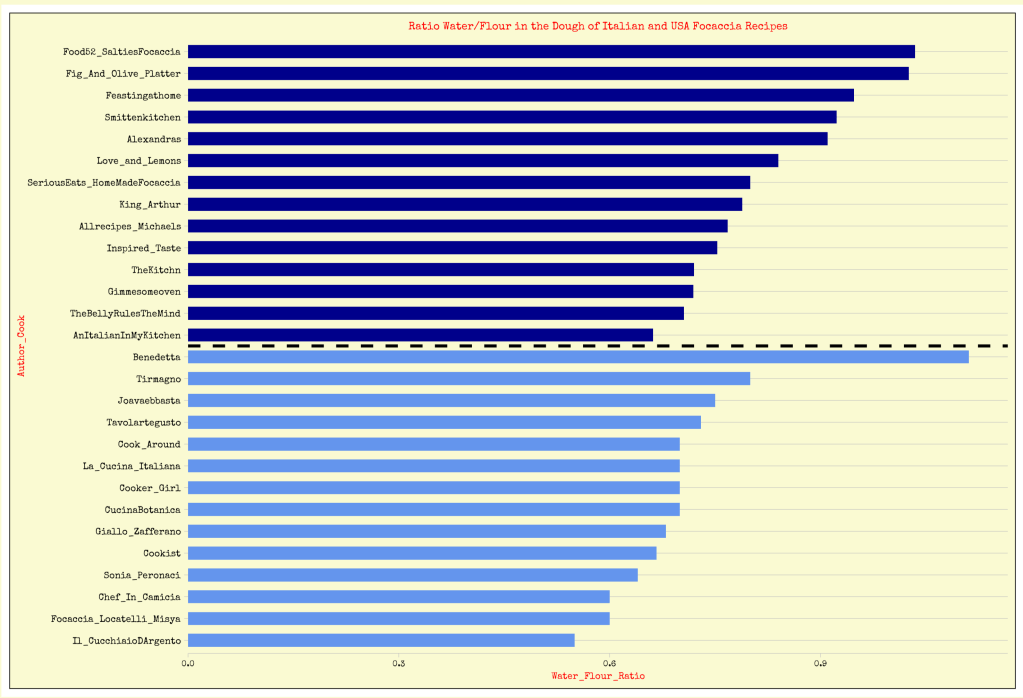
Here is a comparison between the two countries regarding the water-to-flour ratio in the dough. Here, we see that the recipe used by Garner has high hydration, making it a dough considered more difficult to work with (hence oil in the bowl can help when folding).
References
Gandolfo, F. (2022, August 7). OLIO NELL’IMPASTO? SI O NO? E QUALE? – Lievitomania. Lievitomania. https://www.lievitomania.it/2022/08/07/olio-nellimpasto-si-o-no-e-quale/
McGee, H. (2004). Il Cibo e La Cucina. Franco Muzzio Editore. Italian Edition. Pages 344-345.
- Love_and_lemons https://www.loveandlemons.com/focaccia/
- Alexandras https://alexandracooks.com/2018/03/02/overnight-refrigerator-focaccia-best-focaccia/
- Inspired_Taste https://www.inspiredtaste.net/19313/easy-focaccia-bread-recipe-with-herbs/
- King_Arthur https://www.kingarthurbaking.com/recipes/big-and-bubbly-focaccia-recipe
- Gimmesomeoven https://www.gimmesomeoven.com/rosemary-focaccia-bread/
- Feastingathome https://www.feastingathome.com/focaccia/
- Allrecipes_Michales https://www.allrecipes.com/recipe/105038/michaels-foccacia-bread/
- Fig_And_Olive_Platter https://figandoliveplatter.com/how-to-make-focaccia-bread/#wprm-recipe-container-4184
- TheBellyRulesTheMind https://thebellyrulesthemind.net/focaccia-bread-recipe/
- AnItalianInMyKitchen https://anitalianinmykitchen.com/easy-focaccia/
- TheKitchn https://www.thekitchn.com/skillet-focaccia-bread-recipe-261454
- Food52_SaltiesFocaccia https://food52.com/recipes/28786-saltie-s-focaccia
- SeriousEats_HomeMadeFocaccia https://www.seriouseats.com/easy-no-knead-focaccia
- Smittenkitchen https://smittenkitchen.com/2018/08/focaccia-sandwiches-for-a-crowd/
The R Project for Statistical Computing. https://www.r-project.org/
Tidyverse – R packages for data science. https://www.tidyverse.org/
Tidyplots. https://tidyplots.org/

 casaboston.blog
Leave a comment