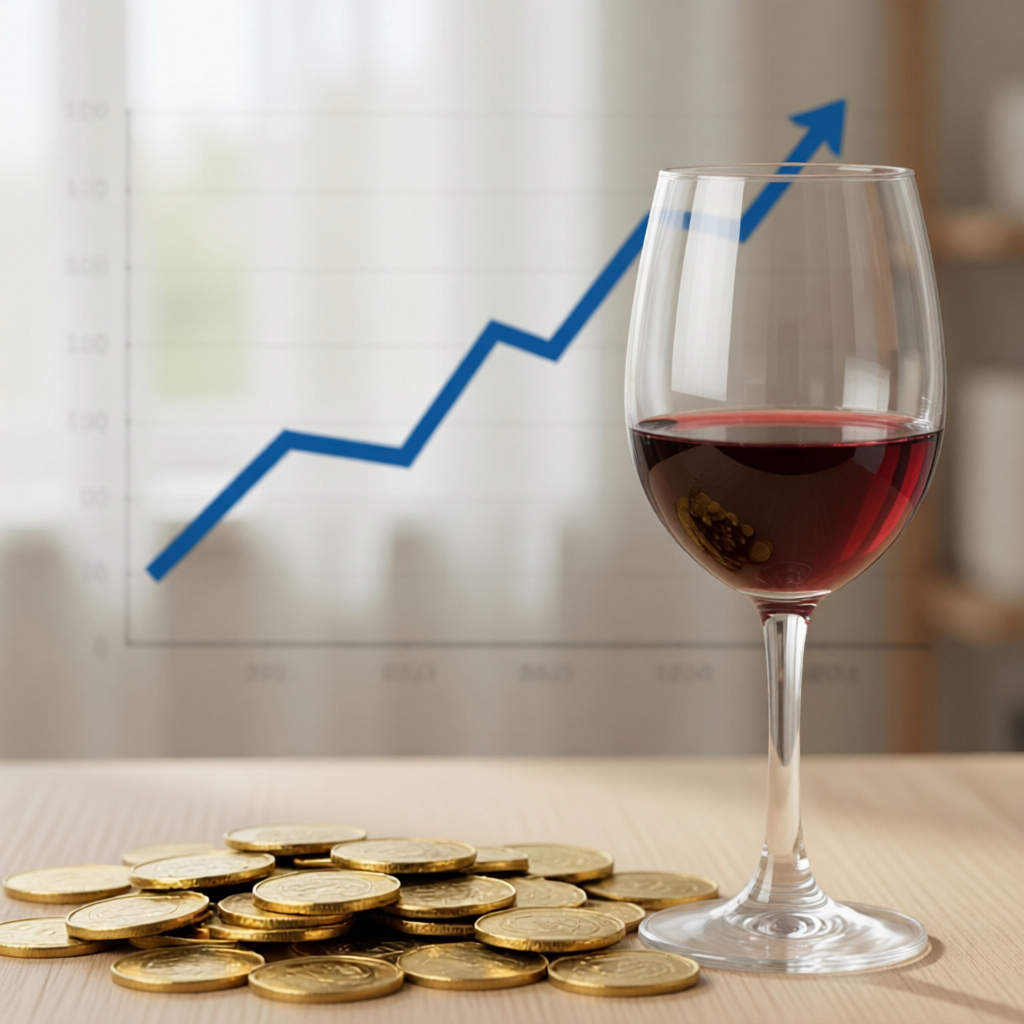
Everyone knows I am a big R Quarto fan, but I also love food and wine, and I am always looking for an excuse to combine data with the culinary universe. This time the news served up a juicy dish on a silver plate. According to the Financial Times, 30,000 bottles of wine were stolen in Tuscany, Italy from the prestigious Marchesi Antinori wine producer, worth about €5 million (Khalaf, 2026). Investigations are still ongoing. Nor is this an isolated case. At the end of September 2026, another wine robbery took place in Piedmont, in the North of Italy. In that case, burglars stole 3,000 bottles of valuable Barolo wine.
On the flip side, according to an article by Dell’Orefice (September 2026), Italian wines recorded negative trends in 9 of the most important 10 markets as of June 2026.
So, why these wine crimes? Who will the thieves sell to?
One obvious answer is that prices are positive even if markets are stalled, so there is still money to be made. But there are other, potentially more interesting factors involved. I did some digging to discover more about the Italian wine markets, and here I share what I found visually, using my Quarto Dashboard.
Grape varieties
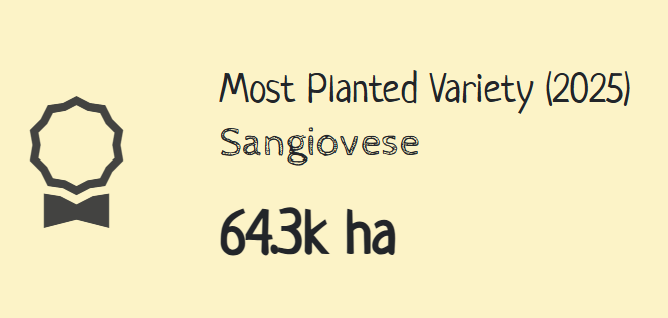
In 2025, Sangiovese was still the most popular grape in terms of hectares planted: 64.3k hectares. This was down from 81.7k hectares in 2005, a drop of 17.4k.
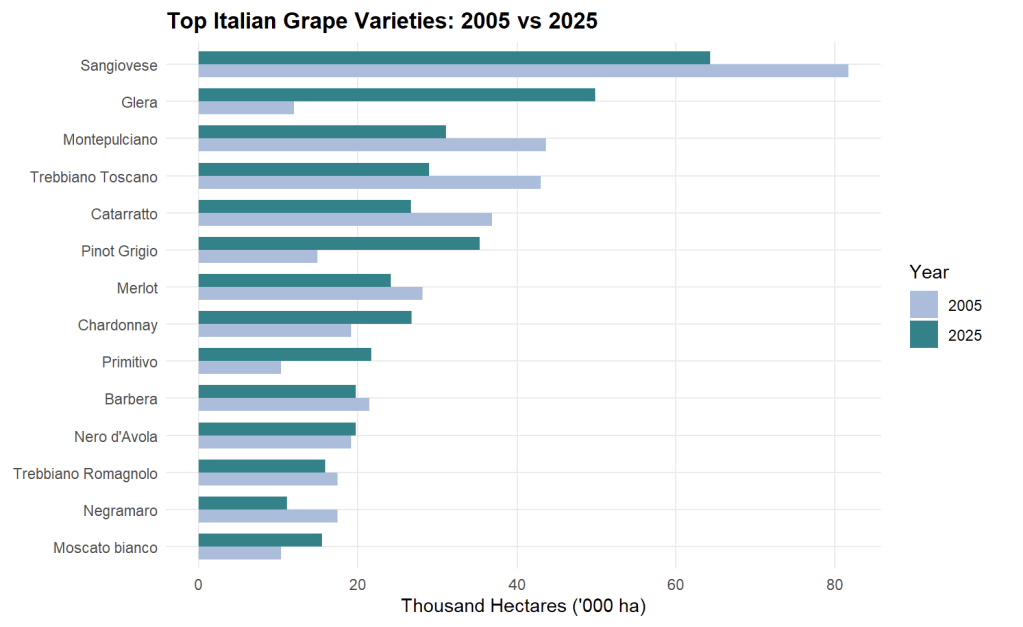
Sangiovese is a common grape variety in many areas of Italy, and Romagna, the Region where I come from, has shared it with Tuscany for centuries. According to one history of the grape, the first written reference in Romagna dates to 1651, under the name “Sanzuvesa”. Emilia-Romagna is also the fifth largest wine-producing region in Italy, and Romagna makes about two-thirds of its production.
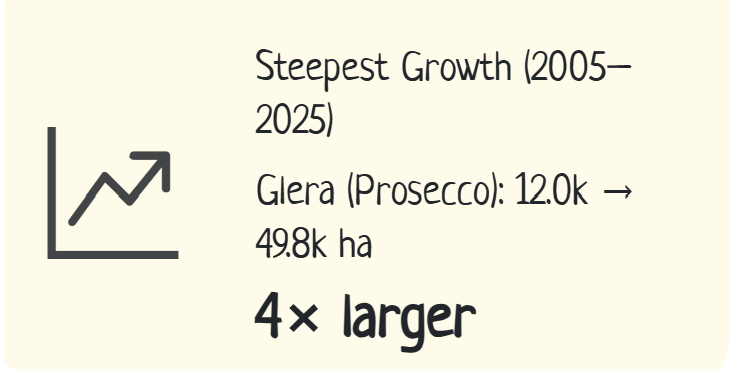
The reason for that massive growth in Glera grape is that it is used for prosecco, and the market for Italian sparkling wine has been expanding as shown below.
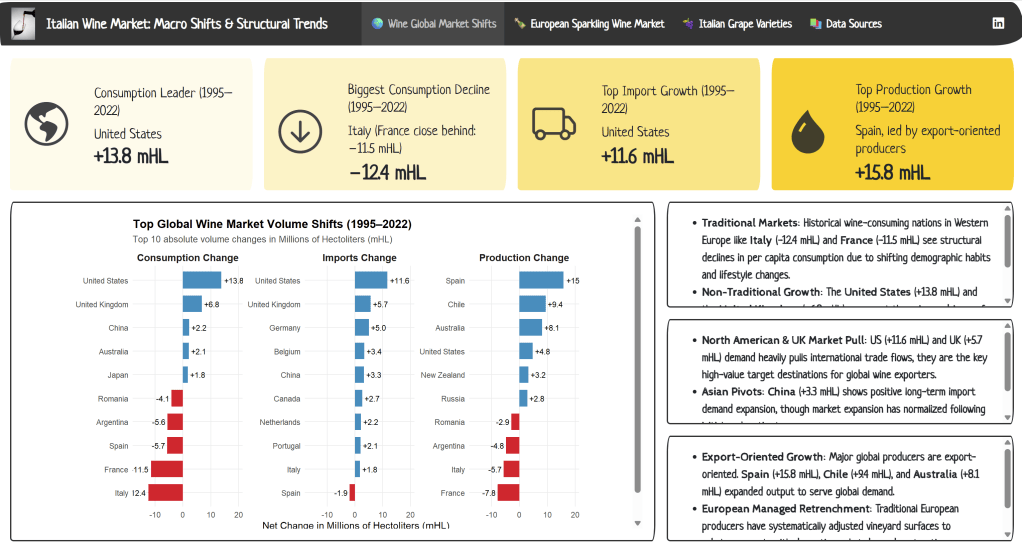
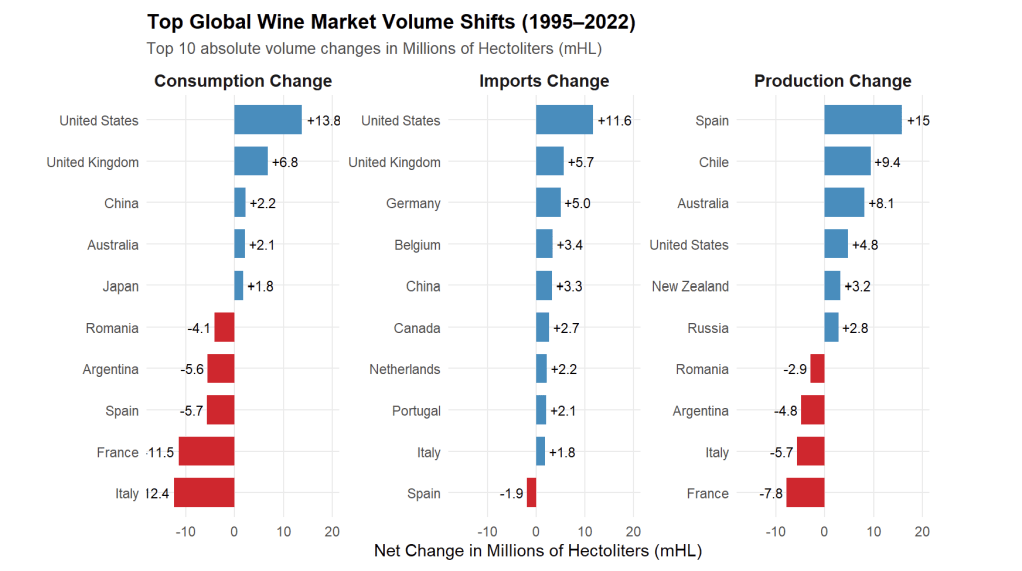
Wine data is spread across many sources, and to see the big picture, not only today’s negative trends, I looked back to 1995, using data from the International Organization of Vine and Wine (OIV). This way, I could assess the patterns between 1995 and 2022, a decent span of time. Traditional wine countries are drinking less: according to data between 1995 and 2022, Italy’s consumption fell by 12.4 million hectoliters and France’s by 11.5. The growth was elsewhere: in the United States consumption went up by 13.8 million hectoliters, and in the United Kingdom by 6.8. It would be interesting to evaluate the effect of Trump’s tariffs on U.S. consumption.
Sparkling wine tells a different story. Italy’s exports almost doubled between 2016 and 2025, from €1.2B to €2.3B.
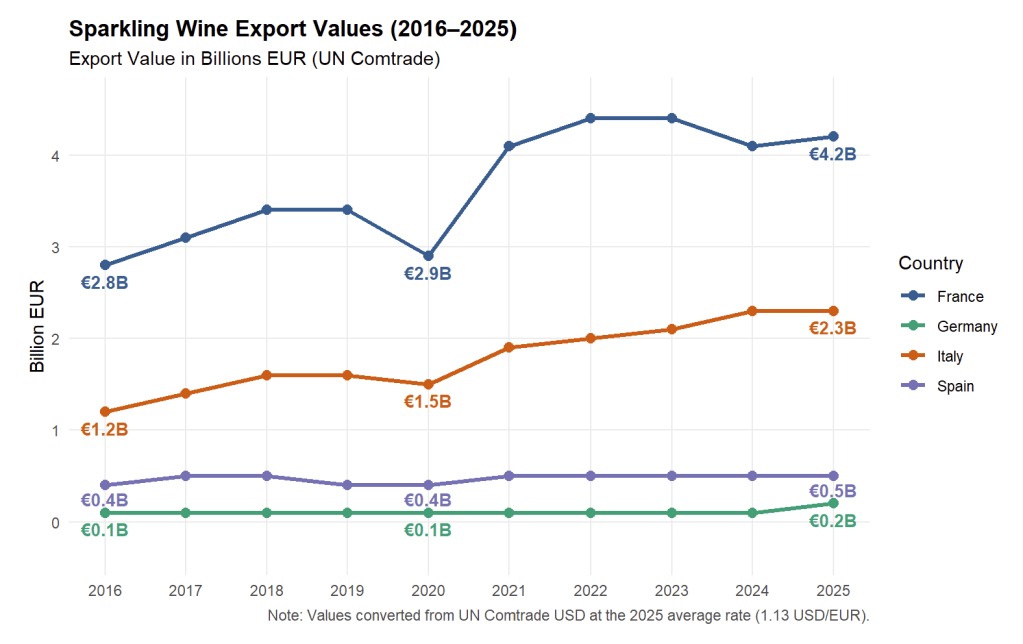
Still, France holds 56% of global sparkling export value (€4.2B) and Italy 31%. [Tab 2 cards]
What comes next?
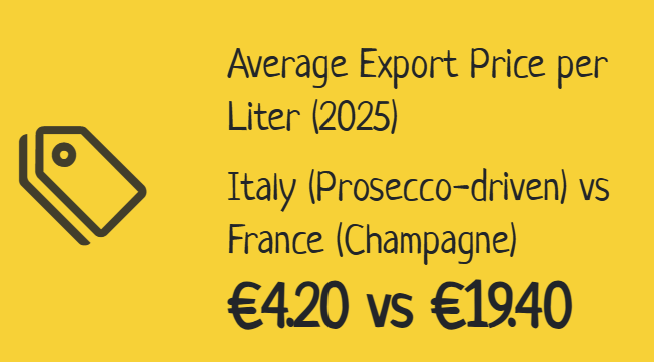
Can Prosecco carry the sector? Glera grew from 12.0k to 49.8k hectares, and sparkling exports reached €2.3B. But Italy earns €4.20 per liter, against €19.40 for France. Is volume enough? Can lower-margin exports fully offset the structural decline in domestic still wine consumption?
What happens to Sangiovese?
It is still number one at 64.3k hectares, but it has lost 17.4k since 2005.
What about the harvest?
As farmers reallocate land toward high-demand grapes like Glera, what happens to regional biodiversity, heritage varieties, and traditional red winemaking?
Unpredictable weather across Northern and Central Italy adds another layer of vulnerability for growers adjusting to global market swings.
Returning to the initial question. Why the wine crimes? Is the wine market split?
Data suggest that this is the case. Top labels are still valuable enough to steal (Reporter Gourmet calls top labels “safe-haven assets”), while volume wine struggles. An article published on the Bordeaux Index website writes, “The Super Tuscans – particularly Sassicaia and Tignanello – have emerged as one of the greatest fine wine investment success stories over the last five years.” (“Fine Wine’s Historic Performance Over Time,” June 23, 2023, by Lucy Shaw). In fact, 9 of the 10 wines with the highest 5-year returns were Super Tuscans, and 8 were produced by Antinori. It is probably not coincidental that these were precisely the wines targeted by the Tuscan thieves.
What’s your take? I’d love to hear your thoughts in the comments below!
Explore the full interactive Quarto dashboard here
References List
- Baccaglio, M. (I numeri del vino). La superficie vitata in Italia per vitigno e categoria – Aggiornamento 2025 (dati ISMEA/AGEA). Analysis of Italian vineyard acreage and grape variety rankings (~64k ha Sangiovese). https://www.inumeridelvino.it/2026/08/la-superficie-vitata-in-italia-per-vitigno-e-categoria-aggiornamento-2025-ismea-agea.html
- Baccaglio, M. (I numeri del vino). Produzione di vino Italia 2025 – dati ISTAT. Analysis of ISTAT regional harvest volumes and agricultural statistics. https://www.inumeridelvino.it/2026/07/produzione-di-vino-italia-2025-dati-istat.html
- Baudains, R. (January 27, 2026). 13 wines to help you understand Sangiovese from Romagna. Decanter. https://www.decanter.com/premium/13-wines-to-help-you-understand-sangiovese-from-romagna-571747/
- Financial Times. Fine wine market trends & trade dynamics. https://www.ft.com/content/1b614d60-a5d3-4b9f-b3e8-63f51bdfd599
- Il Sole 24 Ore. Italian wine exports down 6.2 per cent in the first half of the year. https://en.ilsole24ore.com/art/italian-wine-exports-down-62-per-cent-in-the-first-half-of-the-year-AJ7h7aAB
- International Organisation of Vine and Wine (OIV). Global Wine Database (1995–2022). Raw bulk dataset
data.xlsxprocessed in R (tidyverse). https://www.oiv.int/what-we-do/statistics
- Istituto Nazionale di Statistica (ISTAT). Produzioni agricole e zootecniche – Anno 2025. Press release / Focus Report. https://www.istat.it/comunicato-stampa/produzioni-agricole-e-zootecniche-anno-2025/
- Karlsson, P. (July 2, 2026). Discover the great wines of Romagna: Sangiovese, Albana, Rebola and more. BKWine Magazine. https://www.bkwine.com/features/wine-regions/discover-romagna-sangiovese-albana-rebola/
- Reporter Gourmet. (September 30, 2026). 3,000 bottles stolen in three hours in Piedmont: gang raids a Barolo institution. https://reportergourmet.com/en/wine-reporter/1163-3000-bottles-stolen-in-three-hours-in-piedmont-gang-raids-a-barolo-institution
- Shaw, L. / Bordeaux Index. Fine Wine’s Historic Performance Over Time. Bordeaux Index Fine Wine & Spirits. https://bordeauxindex.com/learn/articles/fine-wine-historic-performance
- UN Comtrade Database. HS Code 220410 – Sparkling Wine of Fresh Grapes (2016–2025 Export Values and Quantities). Queried via the
comtradrR package and converted at the 2025 average rate (). https://comtradeplus.un.org/


Leave a Reply